1. An integrated study of ion dynamics and population distributions to understand the molecular underpinnings of charge transport through self-assembled solid polymer electrolytes. Funded by the U.S. National Science Foundation.
Access to mechanically robust solid polymer electrolytes with ion mobilities comparable to those of liquid electrolytes constitutes a significant barrier for the development of the high-performance lithium batteries required for the widespread use of electricity produced from renewable sources.[1-3] The widespread adoption of sustainably powered electrical grid load balancing and electric vehicles with longer driving ranges could be drastically accelerated by access to reliable lithium-based energy storage. Disruptive advances in these technologies face challenges stemming from knowledge gaps in the nature of charge transport within solid-like ionic conductors.[4-11] This research plan focuses on understanding the fundamental aspects of ion diffusion through nanostructured polymeric matrices, and on using these insights to guide the design of solid polymer electrolytes for high power density lithium batteries. The goal of this study is to examine the Li+ dynamics and population distribution within nanostructured ionic conductors to understand the mechanisms controlling charge transport through matrices with solid-like mechanical properties and liquid-like ion diffusion.
2. Adaptive Building Enclosure Systems Using Cellular Solid-Solid Phase Change Materials with Variable Transparency. Funded by the U.S. National Science Foundation.
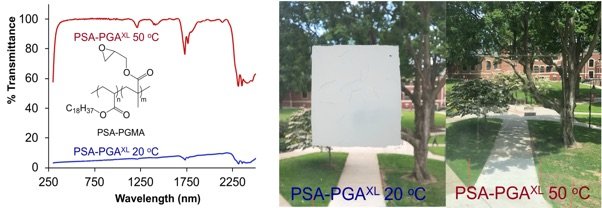
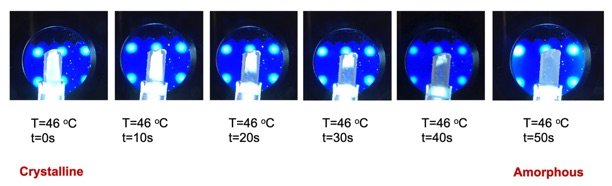
Buildings are responsible for about 40% of US energy consumption; a significant fraction of this energy is needed to counter thermal losses or gains occurring trough the building envelope. So called passive-solar-design approaches seek to balance heat loss through the building envelope with solar energy input, while also using thermal mass, shading, and/or ventilation to dampen diurnal thermal swings. However, implementation of passive-solar-design at the building or building-envelope scale tends to be highly context-specific, requires advanced designer-skills and tools, and often entails use of costly mechanical devices and controls. Furthermore, deployment of passive solar design strategies is challenging in older existing buildings, which are responsible for the bulk of building-related energy expenditures. These factors complicate the widespread use of passive solar design principles in buildings today, thus intensifying the need for energy-efficient building technologies in the building industry. We aim to develop an innovative passive solar building enclosure system that uses cellular solid-solid phase change materials (PCM) with variable transparency. The proposed system not only improves building interior thermal comfort, but also reduces energy use by changing its properties in response to external stimuli.
3. Thermal battery systems for garments. Funded by the U.S. Department of Defense.
When conducting missions in cold weather environments, troops can face a host of weather-related challenges, ranging from numb skin to hypothermia and frostbite that hinder their task performance or even threaten their limbs or lives. Therefore, it is extremely important to provide thermal extremity protection for troops operating in extreme conditions. Currently, there are a series of garments designed to be worn within narrow temperature ranges, such as mittens and boots with progressively higher levels of insulative capacities. Consequently, the use of current generation of extended cold weather clothing systems leads to increased weight and the loss of dexterity, both of which impact mission execution and success. Many alternatives of athletic clothing and sportswear with built-in heating elements are available to maintain thermal comfort. However, the majority of these systems require an external power source, which practically limits their applications in battlefield setting.
This project aims to develop a sorbent-thermo-responsive polymer thermal battery without the use of power, which can store and deliver heat to a solider on demand with material-enabled, passive control mechanisms. Our proposed “thermal battery” allows capturing and storing free heat, for example from solar or waste heat sources, and reusing this heat for various applications afterwards.
4. CO2 Separation Mediated By Proton-Coupled Electron Transfer
Increasing global carbon dioxide (CO2) emissions from the use of fossil fuels in energy conversion processes threatens to accelerate climate change and its associated deleterious effects on human civilization. Climate change mitigation efforts can be supplemented by the capture of CO2 from the atmosphere and point sources. Electrochemical CO2 capture is particularly attractive because, in principle, it can be done using electricity generated from renewable sources such as solar and wind energy, which are becoming increasingly more available. Since substantial CO2 emissions come from mobile sources, and the need to remove significant amounts of this greenhouse gas directly from air has become more urgent, advancing its electrochemical capture in a way that can be achieved at both point sources and the atmosphere has the potential to enable breakthrough real-world applications in carbon capture, utilization and storage. This collaborative study seeks to develop surface-bound redox couples and creating the required interfaces to achieve pH swing-enabled CO2 separation.
5. Synthesis of low-cost non-perfluorinated ion conducting membranes for organic redox flow batteries.
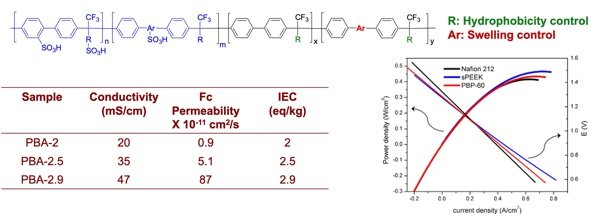
Low-cost, long cycle life flow batteries will be achieved by combining a new type of polyalkylarylene-based separator membranes with rationally designed redox-active quinones. The chemical structure of both the polymer membranes and the quinones will be finely tuned in parallel to maximize conductivity and minimize capacity losses due to crossover and due to degradation of membrane or redox-active species.
Low-cost, highly selective, ion-conducting membranes, are prepared from a new class of sulfonated polyphenylenes. The proton conductivity of these membranes has been measured to be at least 2-4 times higher than Nafion 212. These macromolecules organize into lyotropic liquid crystalline structures with sulfonate-lined hydrated channels that vary in size between 0.8 nm and 2 nm. This channel structure exhibits high selectivity towards solvated ions and excluding larger species, resulting in better device performance. The chemical structure of these membranes was designed to be electrochemically and hydrolytically stable and will remain unaltered over a wide voltage (-2V to +2V vs. sat. calomel) and pH (-2 to 14) window.
Selected recent publications.
Bousselham, R., # Xiao, Z., # Tao, M., Granados-Focil, S., Hera, A., Van Dessel, S. A bio-inspired approach for adaptive solid-solid phase change material coatings with optimized surface features for passive thermal regulation. Solar Energy Materials and Solar Cells, 2026, 295, 114000. Link
Xiao, Z., # Bousselham, R., # Tao, M., Granados-Focil, S., Mangoubi, O., Van Dessel, S., Machine learning-optimized porous thermally responsive SS-PCM with switchable transparency for adaptive building envelope coatings. Energy and Buildings, 2025, 349, 116593. Link
Fell, E., # De Porcellinis, D., Jing Y., Gutierrez-Venegas, V., Gordon, R., Granados-Focil, S., Aziz, M., Long-term stability of ferri/ferrocyanide as an electroactive component for redox flow battery applications: On the origin of apparent capacity fade. Journal of the Electrochemical Society, 2023, 170 (7), 070525. Link.
El-Ouaragli J., # Xiao Z., # Nejad A.M., Tao, M., Granados-Focil, S., Van Dessel, S., A novel passive polymer-sorbent thermal battery for low temperature energy applications: A numerical feasibility study. Journal of Energy Storage, 2022, 56, 105971. Link
Xiao, Z., Mishra, P., Nejad, A.M., Tao, M., Granados-Foci, S., Van Dessel, S., Energy and Buildings, 2021, 247, 111129. Link
Zhang Z. #, Tompsett, G.A., Lambert, C., Granados-Focil, S., Timko, M.T., Rational Design of Solid-Acid Catalysts for Cellulose Hydrolysis Using Colloidal Theory, Physical Chemistry Chemical Physics, 2021, 23 (17), 10236. Link
Van Dessel, S., Tao, M., Granados-Focil, S., Thermal storage system. U.S. Patent 2021, 10,995,250 Link
Cheng F. #, Tompsett, G.A., Fraga-Alvarez, D.V. *, Romo C. I., McKenna, A.M., Niles, S., Nelson, R.K., Reddy, C.M., Granados-Focil, S., Paulsen A.D., Zhang, R., Timko, M.T., Metal oxide supported Ni-impregnated bifunctional catalysts for controlling char formation and maximizing energy recovery during catalytic hydrothermal liquefaction of food waste. Sustainable Energy & Fuels, 2020, 5(4), 941. Link
Mendes, J.L. *, Gao, W., Martin, J.L. #, Carl, A. D. #, Deskins, N. A., Granados-Focil, S., Grimm, R.L. Interfacial states, energetics, and atmospheric stability of large-grain antifluorite Cs2TiBr6. Journal of Physical Chemistry C., 2020 124, 44, 24289. Link
Martin J.L. #, Soflet, R. *, Carl, A.D. #, Himmelberger, K. M. *, Granados-Focil, S. Grimm, R.L., Quantification of surface reactivity and step-selective etching chemistry on single-crystal BiOI (001). Langmuir, 2020, 36, 9343. Link
Mishra, P.,K., Stockmal, K.A., Ardito, G., Tao, M., Van Dessel, S., Granados-Focil, S., Optical
and thermal properties of selected solid-liquid phase-change materials. Solar Energy, 2020, 197, 222. Link
Dillingham, P.W., Alsedi, B.S.O., Granados-Focil S., Radu, A., McGraw, C., Establishing meaningful limits of detection for ion-selective electrodes and other non-linear sensors.
ACS Sensors, 2020, 5, 250 Link.
Crespilho, F.N., Sedenho, G.C., De Porcellinis, D., Kerr, E., Granados-Focil, S., Gordon, R.G., Aziz, M.J., Non-corrosive, Low toxicity, Gel-based Microbattery from Organic and Organometallic Molecules, Journal of Materials Chemistry A, 2019, 7, 24784. Link
Yu, X.#; Burnham, N., Granados-Focil, S.; Tao, M.; Bitumen’s microstructures are correlated with its bulk thermal and rheological properties. FUEL, 2019, 254, 115509, Link
Zhang, M. #, Zhao, M. #, Zhang, G., Sietnis, J. M., Granados-Focil, S., Pepi, M. S., Xu, Y., Tao, M., and Granados-Focil, S. Reaction kinetics of red mud-fly ash based geoplymers: Effects of curing temperature on chemical bonding, porosity, and mechanical strength, Cement and Concrete Composites, 2018, 93, 175-185 Link
De Porcellinis, D., Mecheri, B., D’Epifanio, A., Licoccia, S., Granados-Focil, S., Aziz, M.J. Sulfonated Poly (ether ether ketone) as cation exchange membrane for alkaline redox flow batteries, Journal of the Electrochemical Society, 2018, 165 (5), A1137-A1139. Link
Guldentops, G.#, Ardito, G.#, Tao, M., Granados-Focil, S., Van Dessel, S., A numerical study of adaptive building enclosure systems using solid-solid phase change materials with variable transparency. Energy and Buildings, 2018, 167, 240-252. Link
Tyufekchiev, M.; Duan, P.; Schmidt-Rohr, K.; Granados-Focil, S.; Timko, M.T.; Emmert, M., Cellulase-Mimetic Solid Acids for Cellulose Hydrolysis: Structural Explanations for High Catalytic Activity, ACS Catalysis. 2018, 8, 1464-1468. Link
Fallahi, A., Guldentops, G., Tao, M., Granados-Focil, S., Van Dessel, S., Review on solid-solid phase change materials for thermal energy storage: Molecular structure and thermal properties. Applied Thermal Engineering, 2017, 127, 1427-1441. Link
Wei, J.,# Trout, W.,* Simon, Y., Granados-Focil S., Ring Opening Metathesis Polymerization of Triazole-Bearing Cyclobutenes: Diblock copolymer synthesis and evaluation of the effect of side group size on polymerization kinetics. Journal of Polymer Science Part A, Chemistry, 2017, 55 (11) 1929-1939. Link